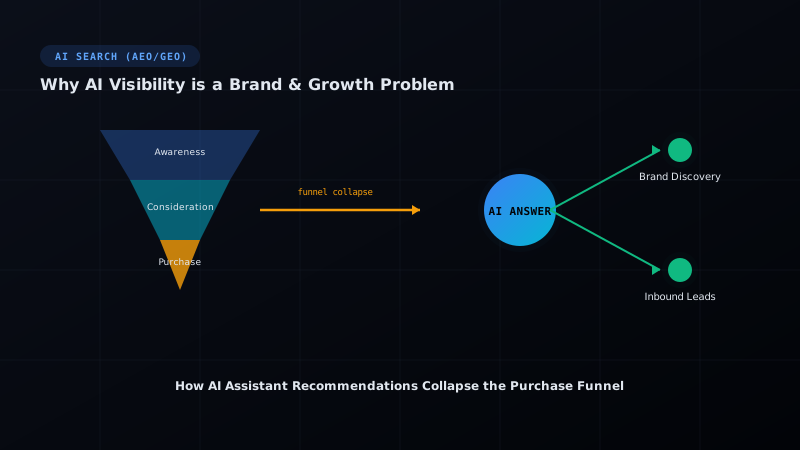
 AI answer engine layer reshaping brand discovery, trust, and revenue growth signals.
AI visibility is no longer only a search issue; it is a brand, growth, and revenue problem.
AI answer engine layer reshaping brand discovery, trust, and revenue growth signals.
AI visibility is no longer only a search issue; it is a brand, growth, and revenue problem.
The CMO's blind spot
Most C-suite conversations about AI focus on internal efficiency: how to use AI to write faster, automate workflows, or analyze data. Those are valid operational improvements.
But there's a far more consequential AI conversation that almost no leadership team is having: how AI is changing the way customers discover, evaluate, and choose brands.
When a VP of Marketing asks their team "Are we visible in AI answers?" the most common response is silence. Nobody owns it. Nobody measures it. Nobody even knows how to check.
This isn't a niche concern. This is the most important brand visibility question of the next decade.
AI is reshaping the entire funnel — simultaneously
Traditional marketing thinks in funnel stages. Awareness campaigns at the top. Consideration content in the middle. Conversion tactics at the bottom. Each stage has its own team, budget, and metrics.
AI collapses this entire funnel into one moment. When someone asks an AI assistant "What CRM should a 50-person fintech use?" the AI's answer handles awareness (which brands exist), consideration (how they compare), and recommendation (which one to choose) — all in a single response.
This means AI visibility isn't a top-of-funnel problem or a bottom-of-funnel problem. It's an every-stage problem. And it's happening whether you're managing it or not.
Why this is a brand problem, not a marketing problem
Marketing can optimize campaigns, adjust messaging, and target new channels. But AI visibility is fundamentally about how AI models understand your brand at a structural level.
- Does AI know your brand exists? Awareness.
- Does AI understand what makes you different? Positioning.
- Does AI trust your claims enough to repeat them? Credibility.
- Does AI accurately represent your value when it mentions you? Brand integrity.
These aren't marketing metrics — they're brand health metrics. And unlike traditional brand metrics that change slowly through campaigns and PR, AI brand perception can shift with a single model update.
If your brand's Wikipedia page is outdated, if your structured data is inconsistent, if there's a competitor with a similar name getting conflated with yours — AI models will encode those problems and repeat them to thousands of users who will never come to your website to learn the truth.
Why this is a growth problem, not a PR problem
The revenue implications are immediate and measurable.
Consider a B2B SaaS company in the project management space. If ChatGPT recommends three competitors but not them in response to 1,000 daily queries about "best project management tools" — that's 1,000 daily missed brand impressions at the exact moment of buying intent.
Over a quarter, that's 90,000 missed high-intent impressions. Even a conservative 2% conversion rate means 1,800 lost leads that the brand will never know about — because they never entered any trackable funnel.
This isn't a hypothetical. We've worked with brands that discovered they were missing from 90%+ of relevant AI responses. The moment they fixed their AI visibility, inbound inquiries increased 3-4x within a single quarter.
Treating AI visibility as a strategic discipline
The organizations that will win the AI visibility transition are treating it as a strategic discipline — not a one-off project or a marketing experiment.
This means:
Board-level awareness. Leadership needs to understand that AI visibility is a competitive moat, not a marketing tactic. Competitor investments in this space compound — early movers gain advantages that late entrants will find expensive to overcome.
Cross-functional ownership. AI visibility sits at the intersection of brand strategy, content, product, and data. No single team can solve it alone.
Continuous measurement. Unlike SEO rankings that update daily, AI model training happens periodically. You need monitoring systems that track how AI perceives your brand across models, across queries, over time.
Structural investment. Quick content fixes won't drive lasting change. You need to invest in how your brand's information is structured, corroborated, and maintained across every surface that AI models learn from.
The brands that build this discipline now won't just be visible in AI answers — they'll be the answers AI is most confident recommending.
Article Blueprint & Semantic Schema
Taxonomy Path
AI Search (AEO/GEO)visibility citations
Target Audience
Growth Architects, CMOs, SaaS Founders, Brand Directors
Editorial Purpose & Goal
Analyze why generative engine visibility is a core brand and growth metric for modern SaaS companies.
Tone & Voice Profile
Strategic, authoritative, revenue-driven.
Content Flow Map (Structure)
Semantic Keywords (GEO/AEO Vectors)
This content continues below
The remaining 70% of this unredacted technical blueprint is locked. Enter your email to grant access.