In the generative search era, the optimization landscape has undergone a tectonic shift. Traditional keyword matching is no longer sufficient; success now requires optimizing for large language models, retrieval-augmented generation (RAG) pipelines, and structured answer engines.
AI-driven query responses extract raw factual claims directly from authoritative data structures. To remain visible, brands must execute comprehensive data optimization strategies built around Wikidata setups, Google Knowledge Graph, entity codes, semantic authority.
The AI Crawler Retrieval Process
Traditional search engine crawlers index links based on visual keywords and backlink popularity. In contrast, generative AI crawlers search for semantic patterns and construct dynamic knowledge graphs.
If your site is not structured for semantic extraction, the LLM will ignore your pages, and you will lose organic traffic.
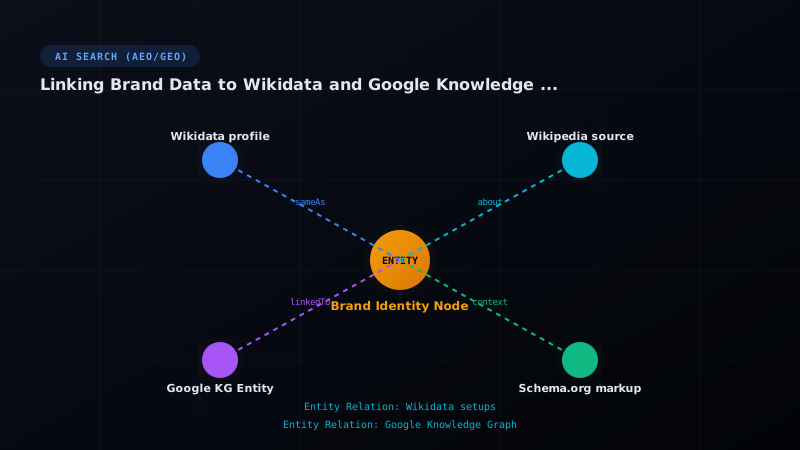 Technical diagram illustrating Linking Brand Data to Wikidata and Google Knowledge Graph mapping Wikidata setups and Google Knowledge Graph.
Figure 1: Conceptual blueprint for linking brand data to wikidata and google knowledge graph demonstrating the integration of Wikidata setups and Google Knowledge Graph.
Technical diagram illustrating Linking Brand Data to Wikidata and Google Knowledge Graph mapping Wikidata setups and Google Knowledge Graph.
Figure 1: Conceptual blueprint for linking brand data to wikidata and google knowledge graph demonstrating the integration of Wikidata setups and Google Knowledge Graph.
Interactive AI Retrieval Simulator
Interactive Simulator (aeo geo-retrieval)Stage 1/4"User inputs natural query into GenAI search engine..."
0%
Technical Schema Optimization
To rank in AI answers, you must make it easy for AI crawlers to parse your site entities. The most effective way is by deploying detailed JSON-LD Schema markups:
{
  "@context": "https://schema.org",
  "@type": "TechArticle",
  "headline": "Linking Brand Data to Wikidata and Google Knowledge Graph",
  "about": {
    "@type": "Thing",
    "name": "AEO",
    "sameAs": "https://en.wikipedia.org/wiki/Answer_Engine_Optimization"
  },
  "author": {
    "@type": "Organization",
    "name": "GAEO.ai"
  }
}
Establishing Crawling Context
Establish crawling and agent context. Publish clean, crawlable HTML, maintain accurate sitemaps, and use structured data where it helps search engines understand entities, products, services, articles, and relationships. GAEO can also generate llms.txt for developer-facing LLM agents and retrieval tools, but Google Search’s generative features rely on standard crawlability, indexation, quality systems, and structured web signals — not a special AI text file.
Article Blueprint & Semantic Schema
Taxonomy Path
AI Search (AEO/GEO)schema entities
Target Audience
AEO/GEO Directors, SEO Managers, CMOs, Brand Directors
Editorial Purpose & Goal
Instruct search specialists on optimizing linking brand data to wikidata and google knowledge graph to secure citations and maximize brand visibility inside AI generative search results.
Tone & Voice Profile
Forward-looking, search-native, authoritative, deeply technical.
Content Flow Map (Structure)
Semantic Keywords (GEO/AEO Vectors)
This content continues below
The remaining 70% of this unredacted technical blueprint is locked. Enter your email to grant access.