
Direct Answer (Thesis): ACP (Agentic Commerce Protocol), AP2 (Agent Payments Protocol), and UCP (Universal Commerce Protocol) are not competing acronyms solving the exact same problem—each originates from a different layer of the commerce architecture and addresses a distinct operational question. ACP focuses on checkout session orchestration between AI platforms and merchants; AP2 focuses on cryptographic payment mandates and delegated authorization across payment rails; and UCP focuses on standardizing catalog, inventory, and full order-lifecycle schemas across heterogeneous commerce systems.
Epistemic note: Protocol specifications in agentic commerce are evolving rapidly across AI platforms, payment networks, and commerce infrastructure providers. This field note presents GAEO.ai's comparative analytical lens for executives and architects evaluating the landscape.
Why Protocol Alphabet Soup Happens in Emerging Shifts
Whenever a new computing interface emerges, infrastructure providers rush to standardize how systems talk to one another. As shopping and procurement shift from human browser sessions to autonomous AI agents, merchants face a practical question:
If a customer asks an AI assistant to find, compare, and buy a product from our store, how does the agent actually read our catalog, verify permission, pay safely, and manage the order?
Three prominent protocol initiatives—ACP, AP2, and UCP—have emerged to answer that question. Because each initiative is shaped by the vantage point of its creators (AI platforms and checkout providers vs. payment networks vs. commerce platform ecosystems), each emphasizes a different part of the transaction.
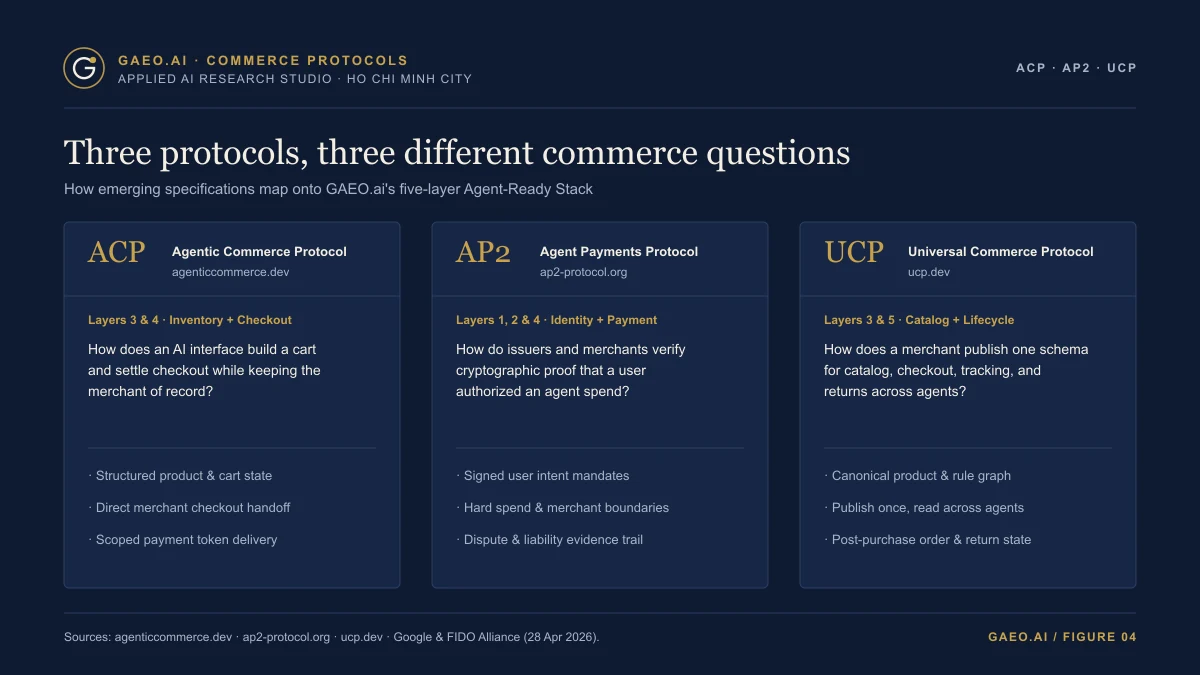
Side-by-Side Comparison: ACP vs. AP2 vs. UCP
| Dimension | ACP (Agentic Commerce Protocol) | AP2 (Agent Payments Protocol) | UCP (Universal Commerce Protocol) |
|---|---|---|---|
| Core Question Answered | How does an AI agent construct a cart and complete a merchant checkout flow directly from an AI interface? | How do payment networks, issuers, and merchants verify that an AI agent has cryptographic permission to spend a user's money? | How do merchants expose a unified, machine-readable schema for catalogs, rules, checkout, and post-purchase order state to any agent? |
| Primary Layer in GAEO's Agent-Ready Stack | Inventory + Checkout Bridge (Layers 3 & 4) | Identity + Permission + Payment (Layers 1, 2 & 4) | Inventory + Full Order Lifecycle (Layer 3 & Layer 5 Recourse) |
| Primary Technical Focus | Standardized product feed ingestion, real-time cart/tax/shipping calculation, and delegated checkout session handoff. | Verifiable cryptographic mandates, scoped spending limits, tokenized credentials, and liability/dispute evidence. | Canonical data models for product attributes, real-time inventory, fulfillment constraints, order tracking, and returns. |
| Main Operational Problem Solved | Eliminates brittle browser screen-scraping during checkout while letting the merchant remain the merchant of record. | Prevents raw card exposure in LLM prompts and gives issuers/merchants cryptographic proof of consumer consent. | Prevents merchants from building bespoke integrations for every individual AI agent platform. |
| What It Does Not Solve Alone | Internal enterprise governance or multi-issuer payment dispute arbitration. | Deep product catalog semantics, complex variant bundling, or post-purchase fulfillment state. | Payment network cryptographic mandate enforcement at the card-issuer level. |
1. ACP (Agentic Commerce Protocol): The Checkout Orchestration Bridge
When an AI assistant recommends a product inside a conversational interface, the friction point is almost always the handoff from discovery to transaction. If the agent attempts to drive a headless browser through a human checkout page, layout changes, popups, and bot checks break the flow.
ACP addresses the question: How can an AI platform and a merchant storefront negotiate a checkout session programmatically while keeping the merchant in control of the order?
- Structured Feed & Cart State: The merchant exposes structured product availability, pricing, shipping options, and tax rules via standardized endpoints.
- Merchant of Record Preservation: Rather than turning the AI platform into a marketplace aggregator that owns the customer relationship, ACP allows the transaction to settle directly with the merchant's existing commerce and payment backend.
- Delegated Payment Token Handoff: Combines cart confirmation with a scoped payment token so checkout completes deterministically.
2. AP2 (Agent Payments Protocol): Cryptographic Mandates & Payment Trust
From the perspective of financial institutions, card networks, and risk engines, an autonomous agent initiating a transaction raises an immediate alarm: No human clicked the "Pay Now" button in a verified checkout session.
AP2 addresses the question: How does an agent prove to a payment processor and card issuer that it has explicit, bounded authority from the account holder?
- Verifiable Intent & Mandates: AP2 introduces cryptographic mandates signed by the user's device or identity provider, specifying who the agent is (
Identity), what it is allowed to buy and up to what amount (Permission), and which tokenized payment instrument may be charged (Payment). - Dispute & Liability Clarity (
Recourse): When a transaction includes a cryptographic mandate proving the user authorized an agent to buy a flight under $500, both the merchant and issuer have verifiable evidence if a dispute arises later.
3. UCP (Universal Commerce Protocol): Understanding the Full Order
Commerce does not end when payment clears. In retail and e-commerce, operational complexity lives in variant compatibility, bundle rules, split shipments, order modifications, cancellations, and returns.
UCP addresses the question: How can a commerce system expose its entire catalog and order lifecycle in a single, standardized machine-readable language across all AI agents?
- Publish Once, Read Everywhere: Instead of maintaining separate custom adapters for every search engine and AI shopping assistant, merchants expose a canonical commerce graph covering discovery, cart state, checkout, and post-purchase customer service.
- Post-Purchase State Synchronization: Enables agents not just to buy an item, but to check delivery status, initiate an exchange, or verify return eligibility using deterministic rules.
How They Map to GAEO.ai's Agent-Ready Stack
Rather than asking "Which single protocol will win?", technical leaders should map these protocols against The Agent-Ready Stack:
- Identity & Permission (Layers 1–2): Look to AP2 and delegated OAuth/cryptographic mandate standards to ensure agents carry verifiable proof of authority.
- Inventory & Order Comprehension (Layer 3): Look to UCP and structured Schema.org /
/llms.txtfoundations so your product catalog, pricing, and policies are cleanly machine-readable before any protocol call occurs. - Checkout & Payment Execution (Layer 4): Look to ACP and AP2 working together to bridge conversational cart creation with tokenized payment settlement.
- Recourse (Layer 5): Regardless of protocol, ensure your internal operations log the full chain of intent, mandate, and execution—and maintain a clear human escalation path when an automated order requires intervention.
Sources
- Agentic Commerce Protocol (ACP) — official site: agenticcommerce.dev
- Agent Payments Protocol (AP2) — official site: ap2-protocol.org
- Universal Commerce Protocol (UCP) — official site: ucp.dev
- Google, "Agent Payments Protocol and the FIDO Alliance" (28 Apr 2026): blog.google