Research / Directions

AI meets
the real world.

We study the operational questions behind AI adoption across retail, fintech, e-commerce, airlines and environmental restoration. These are areas of inquiry, not a catalogue of products or services.

Applied AI and agent commerce

Compare what surveys, experiments and market scenarios tell us about adoption, performance and commerce readiness.

Read the research brief →

Agentic commerce by industry

Market evidence and practical evaluation plans for five sectors.

01 / RESEARCH DIRECTION

Retail & consumer goods

What changes when the customer is an agent?

When AI shopping agents mediate discovery and comparison, retail competition shifts from visual persuasion to machine readability—requiring structured product specifications, real-time inventory APIs, deterministic pricing, and explicit fulfillment rules that autonomous agents can parse and verify.

Product information, discovery, inventory and the operational decisions behind every purchase.
02 / RESEARCH DIRECTION

Fintech & payments

How does an agent earn permission to act?

An AI agent earns permission to transact through cryptographic identity, scoped delegation mandates, and programmable spend boundaries. Instead of sharing raw card details, agentic payment flows (such as AP2) require tokenized authorization, human-in-the-loop thresholds, and auditable recourse paths.

Identity, delegated authority, payment boundaries and a clear path to resolve mistakes.

03 / RESEARCH DIRECTION

E-commerce

Can a system understand the full order?

Understanding the full order requires interoperability beyond checkout: exposing machine-readable catalogs, variant constraints, and protocol-level state synchronization (via ACP and UCP) so agents can manage shipping, order modifications, cancellations, and returns without brittle screen-scraping.

Machine-readable commerce, reliable checkout and service beyond the transaction.

04 / RESEARCH DIRECTION

Airlines

Can automation handle the exceptions?

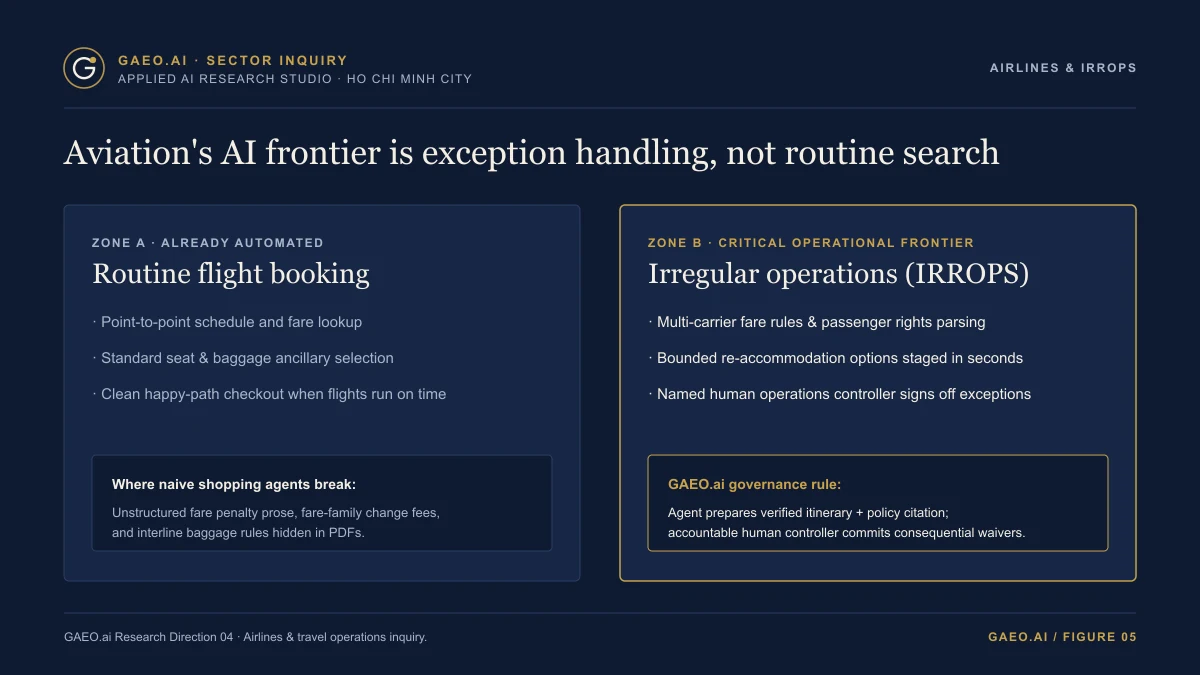
While routine flight booking is already automated, aviation's critical frontier for AI agents lies in irregular operations (IRROPS)—interpreting complex multi-carrier fare rules, schedule disruptions, and passenger rights while coordinating bounded re-accommodation proposals with accountable human controllers.

Complex offers, operational constraints and human oversight across the travel journey.

GAEO.ai sector diagram contrasting automated routine flight booking with irregular operations (IRROPS) exception handling under human controller sign-off
05 / RESEARCH DIRECTION

Environment

Where can AI support restoration?

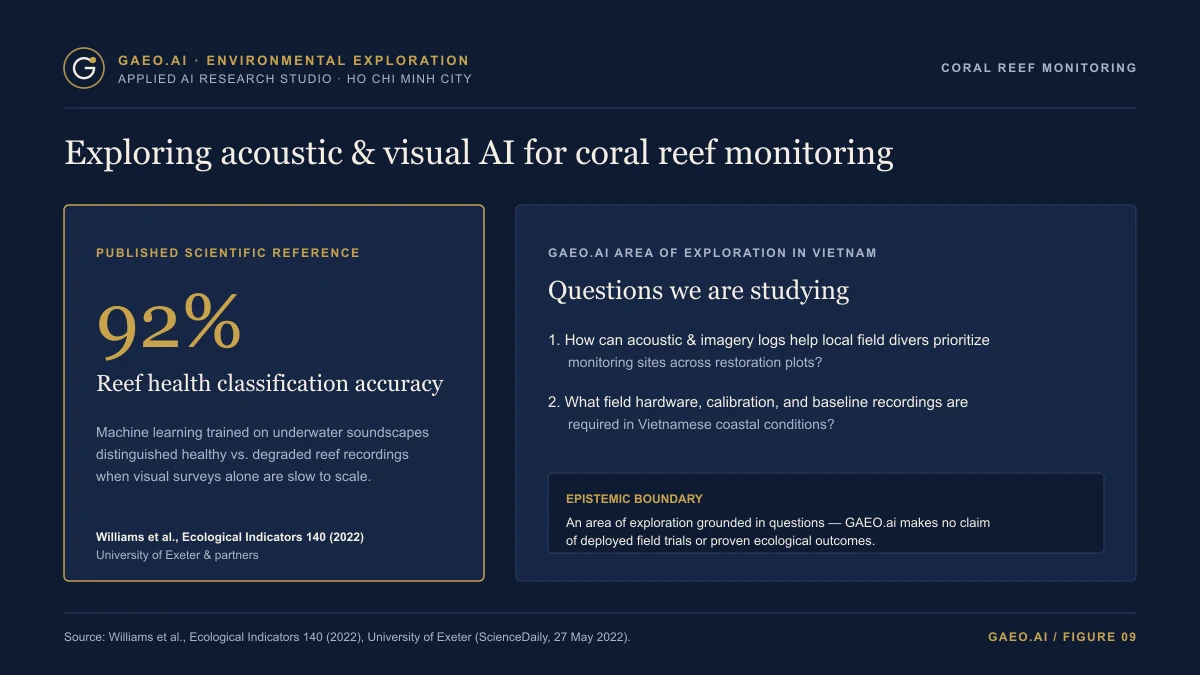
Published marine-acoustics research shows machine learning trained on underwater reef recordings can classify healthy versus degraded reef status with 92 percent accuracy (Williams et al., Ecological Indicators 140, 2022, University of Exeter). GAEO.ai explores how acoustic and visual monitoring methods could assist field teams studying coral reefs in Vietnam—strictly as an area of exploration, with no claim of proven ecological outcomes.

An area of exploration studying AI for coral reef monitoring in Vietnam, grounded in published literature and field questions rather than claimed ecological outcomes.

Reference: Williams et al., Ecological Indicators 140 (2022), University of Exeter (via ScienceDaily) ↗

GAEO.ai environmental exploration diagram referencing Williams et al. (2022) 92% coral reef acoustic classification accuracy alongside open monitoring questions in Vietnam

A working lens

The Agent-Ready Stack

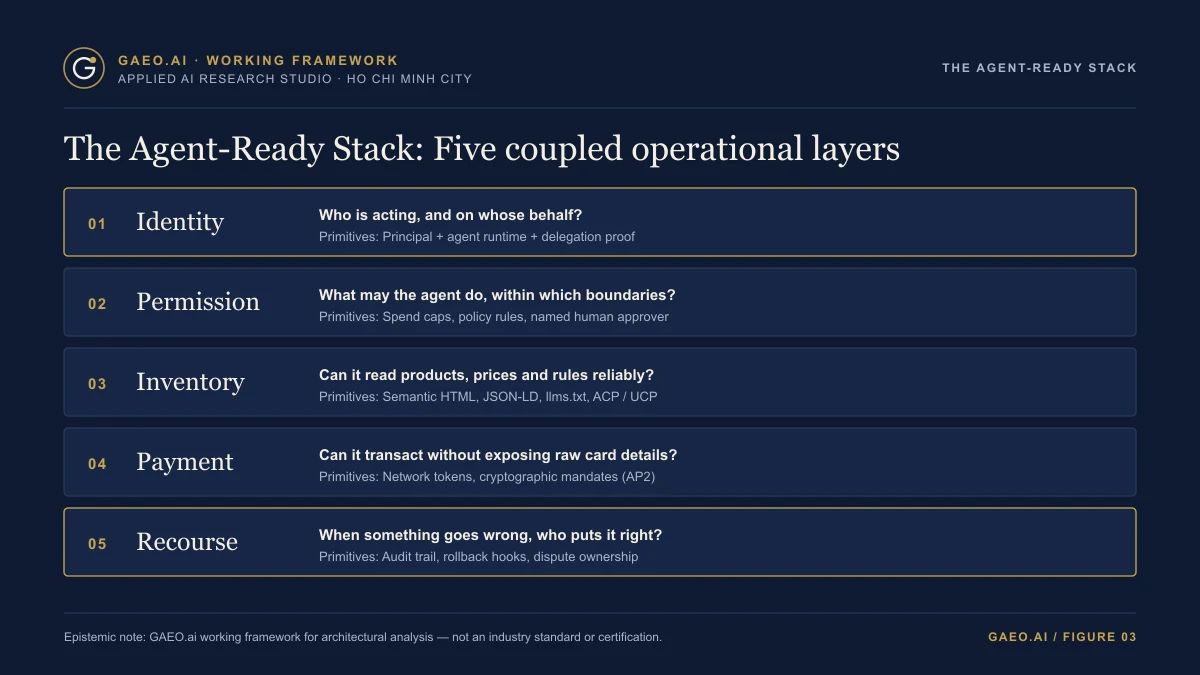
Five layers for systems that let AI agents act and transact. GAEO’s working framework, not an industry standard.

GAEO.ai Agent-Ready Stack diagram showing five layers: Identity, Permission, Inventory, Payment, and Recourse
  1. Identity

    Who is acting, and on whose behalf?

  2. Permission

    What may the agent do, within which boundaries?

  3. Inventory

    Can it read products, prices and rules reliably?

  4. Payment

    Can it transact without exposing raw card details?

  5. Recourse

    When something goes wrong, who can put it right?