
Direct Answer (Thesis): The Agent-Ready Stack is GAEO.ai's five-layer working framework for evaluating whether a business system can safely and reliably support autonomous AI agent transactions. Rather than treating agent readiness as a single API integration, the framework examines five coupled operational layers: 1. Identity, 2. Permission, 3. Inventory, 4. Payment, and 5. Recourse.
Epistemic note: The Agent-Ready Stack is GAEO.ai's working framework for research and architectural analysis. It is not an established industry standard, formal certification, or audited readiness score.
Why Chat Readiness Is Not Transaction Readiness
Most enterprise AI initiatives begin with a conversational layer: summarizing documents, answering customer support questions, or recommending products in a chat window. In that mode, the human remains the final integration layer—reading the answer, verifying whether it makes sense, clicking the checkout button, and entering payment credentials.
Everything changes when the customer or employee delegates the action itself to an AI agent. When an external shopping agent or an internal operations agent interacts directly with your storefront, booking engine, or financial ledger, brittle screen-scraping and human-only checkout assumptions break down.
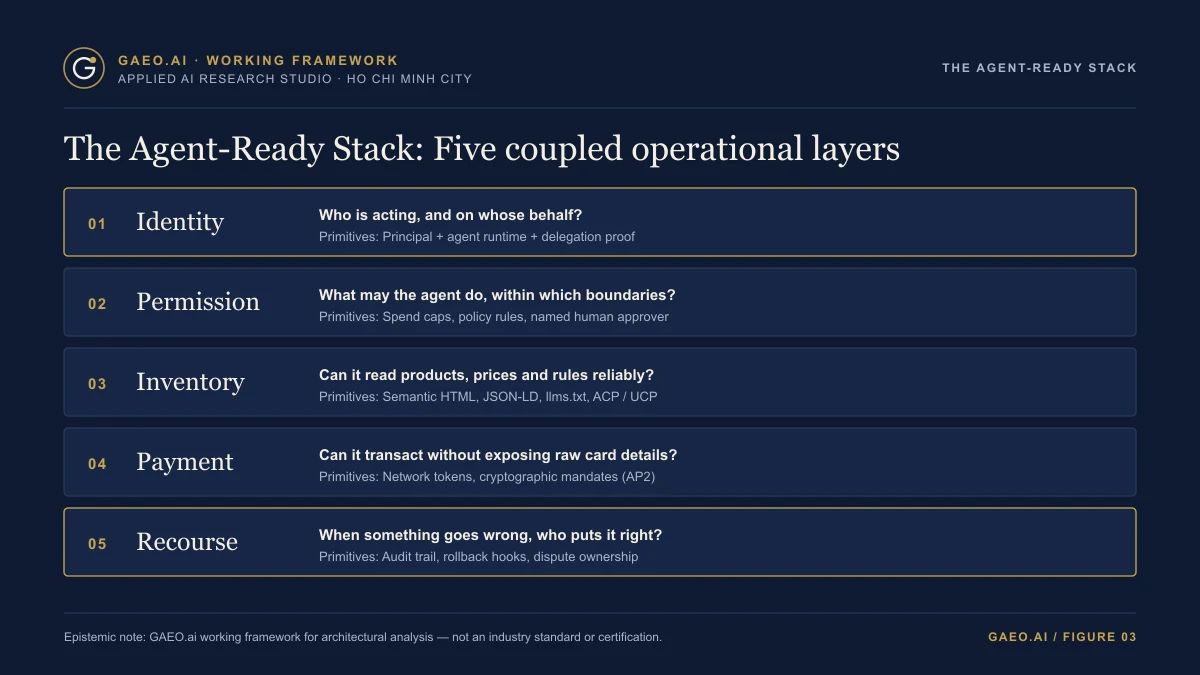
To study what changes between answering a question and completing a transaction, GAEO.ai examines five distinct layers that together form The Agent-Ready Stack.
The Five Layers of the Agent-Ready Stack
Layer 1 — Identity: Who is acting, and on whose behalf?
Traditional web security treats automated traffic as a binary problem: either a request comes from a human browser session, or it is a bot to be throttled or blocked by a Web Application Firewall (WAF).
In agentic operations, an AI agent is neither an anonymous scraper nor the human principal—it is a delegated actor. An agent-ready system must distinguish three separate identities in every session:
- The Principal: The human consumer or enterprise organisation on whose behalf the action is taken.
- The Agent Platform / Runtime: The software agent (e.g., a shopping assistant, procurement agent, or travel concierge) executing the workflow.
- The Delegation Chain: Verifiable cryptographic proof that the principal authorized this specific agent runtime to act in this context.
Without explicit agent identity, businesses face a dual failure mode: blocking legitimate high-intent customer agents at the firewall, or allowing unverified bots to spoof user sessions.
Layer 2 — Permission: What may the agent do, within which boundaries?
Even when an agent's identity is verified, authentication is not authorization. Permission defines the operational envelope within which the agent may act autonomously versus when it must pause and escalate to a named human approver.
Operational permission boundaries include:
- Scope of Action: Can the agent only query availability and assemble a draft cart, or is it permitted to commit a binding order?
- Financial Limits: Hard spend caps per transaction, per merchant category, or per time window.
- Policy Constraints: Approved vendors, delivery windows, fare classes, or return-eligibility rules.
- Human-in-the-Loop Escalation: Explicit triggers that require a human principal to review and sign off before execution proceeds.
Layer 3 — Inventory: Can it read products, prices, and rules reliably?
Human shoppers tolerate visual ambiguity—inferring product compatibility from lifestyle photos, promotional banners, or unstructured PDFs. Autonomous agents cannot rely on visual guesswork when committing funds.
At the Inventory layer, machine readability determines whether an agent selects your product or abandons the transaction:
- Structured Product & Service State: Clean HTML DOM hierarchy, aligned Schema.org JSON-LD, machine-readable feeds (
/llms.txt), and deterministic APIs or protocols (such asUCPandACP). - Real-Time Availability & Pricing: Accurate stock counts, variant-level pricing, tax/shipping calculation, and bundle constraints.
- Explicit Operational Rules: Machine-parseable return policies, cancellation windows, warranty terms, and fulfillment SLAs.
Layer 4 — Payment: Can it transact without exposing raw card details?
Passing raw Primary Account Numbers (PANs) or static CVVs through a language model context window creates severe security, PCI compliance, and fraud risks. At the same time, traditional checkout flows that rely on interactive visual CAPTCHAs or manual 3D Secure popups stall autonomous execution.
An agent-ready Payment layer requires:
- Tokenized & Delegated Credentials: Single-use network tokens or scoped virtual cards bound to a specific merchant and amount.
- Cryptographic Payment Mandates: Emerging standards (such as the Agent Payments Protocol,
AP2) that attach verifiable proof of user intent and spend limits directly to the payment authorization request. - Agent-Aware Fraud Telemetry: Risk scoring models that evaluate delegated agent signals rather than treating non-human pointer movement as automatic fraud.
Layer 5 — Recourse: When something goes wrong, who can put it right?
Models are probabilistic; commerce and operations require deterministic accountability. Sooner or later, an agent will misinterpret an ambiguous constraint, book a non-refundable fare under the wrong rule, or encounter a post-purchase exception.
The Recourse layer asks what happens after a flawed transaction:
- Immutable Audit Trails: Recording the exact user prompt, the inventory state the agent observed, the permission token applied, and the transaction payload executed.
- Deterministic Rollback & Cancellation Hooks: Machine-accessible endpoints for order modification, grace-period cancellation, or return initiation.
- Named Human Accountability: Clear liability rules between the customer, the agent provider, and the merchant—backed by an escalation path to a human operator who has the authority to resolve the dispute.
Summary Diagnostic Matrix
| Layer | Core Operational Question | Primary Technical Primitives | Risk if Neglected |
|---|---|---|---|
| 01. Identity | Who is acting, and on whose behalf? | Signed agent headers, OAuth/OIDC delegation, cryptographic principal binding | WAFs block real customer agents; malicious bots spoof sessions |
| 02. Permission | What may the agent do, within which boundaries? | Scoped mandates, spend caps, policy rules, named human approver gates | Unauthorized commitments or budget overruns on ambiguous prompts |
| 03. Inventory | Can it read products, prices, and rules reliably? | Semantic HTML, Schema.org JSON-LD, llms.txt, ACP/UCP catalog endpoints | Hallucinated specs, stale pricing, or failed checkout parsing |
| 04. Payment | Can it transact without exposing raw card details? | Network tokens, scoped virtual cards, cryptographic payment mandates (AP2) | Credential exposure in prompts or false-positive fraud declines |
| 05. Recourse | When something goes wrong, who can put it right? | Intent-to-action audit logs, dispute rules, human escalation workflows | Unresolvable chargebacks and accountability deadlocks |
Applying the Lens in Practice
When evaluating an AI agent initiative—whether exposing your retail catalog to external shopping agents or deploying internal operational agents in fintech and aviation—start from the bottom and top of the stack simultaneously:
- Can an external system read your rules without guessing? (Inventory)
- Who is authorized to approve the action, and how is a mistake reversed? (Permission & Recourse)
Only when those answers are explicit do protocol integrations at the Identity and Payment layers translate into durable operational value.
Video transcript
[00:00–00:05] The Agent-Ready Stack is GAEO.ai's five-layer working framework for evaluating systems before an autonomous AI agent transacts.
[00:05–00:10] Layer 1 (Identity) verifies principal, agent runtime, and delegation chain; Layer 2 (Permission) enforces spend caps, policy rules, and named human approvers.
[00:10–00:15] Layer 3 (Inventory) exposes clean HTML, aligned Schema.org JSON-LD, and protocol feeds (ACP, UCP) so agents read availability, pricing, and policies without guessing.
[00:15–00:20] Layer 4 (Payment) replaces raw card exposure with network tokens and cryptographic payment mandates (AP2).
[00:20–00:25] Layer 5 (Recourse) records immutable intent-to-action logs, rollback hooks, and human accountability when an automated transaction goes wrong.
Sources
- Agentic Commerce Protocol (ACP) — official documentation: agenticcommerce.dev
- Agent Payments Protocol (AP2) — official documentation: ap2-protocol.org
- Universal Commerce Protocol (UCP) — official documentation: ucp.dev
- Google, "Agent Payments Protocol and the FIDO Alliance" (28 Apr 2026): blog.google