
Direct Answer (Thesis): Measuring enterprise AI adoption purely by individual productivity gains—such as drafting messages, summarizing meetings, or generating code snippets faster—captures only the surface effect of the technology. Durable operational impact emerges only when organisations redesign the underlying workflow: clarifying which inputs are machine-readable, where automated decisions stop, who reviews exceptions, and how outcomes are verified.
Faster Local Tasks Do Not Automatically Produce Faster Systems
In almost every industry we study—retail, fintech, e-commerce, and airlines—early AI pilots report encouraging individual time savings. Analysts summarize reports in minutes instead of hours; support agents draft replies in seconds.
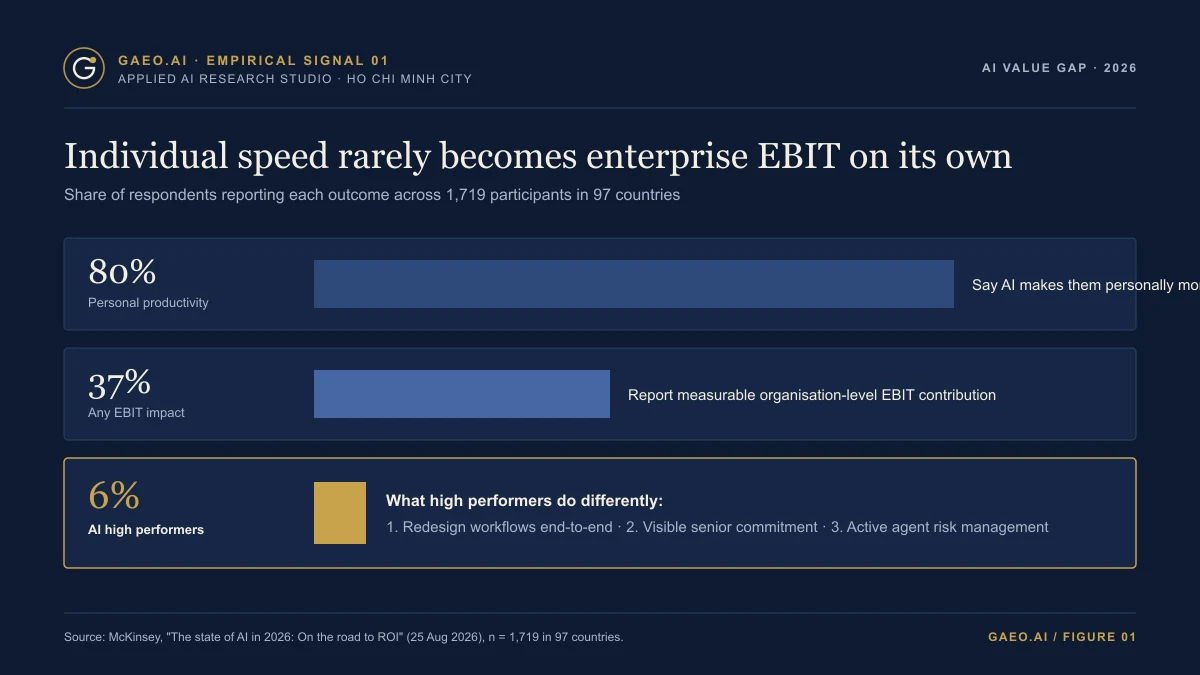
Yet when leaders look at system-level operational metrics—order-to-cash cycle time, exception resolution accuracy, dispute rates, or unit cost per fulfilled transaction—the aggregate improvement is often modest. In McKinsey's August 2026 global survey ("The state of AI in 2026: On the road to ROI", 1,719 respondents in 97 countries), 80 percent of respondents reported that AI makes them personally more productive, yet only 37 percent reported any EBIT impact and just 6 percent qualified as AI high performers—distinguished by redesigning workflows, visible senior commitment, and active risk management of agents.
Why? Because speeding up one step inside a workflow designed around human bottlenecks simply moves the queue to the next verification gate. If an AI assistant generates ten times more draft actions, but human reviewers still have to manually cross-check three disconnected legacy systems to verify whether each draft is safe to approve, the organisation has increased cognitive load rather than operational throughput.
Three Questions for Leaders Assessing AI in Operations
Instead of asking "How many hours did this tool save per employee?", GAEO.ai's research focuses on three structural questions:
- What changed in the information architecture? Are product rules, policies, and operational states now structured so both machines and humans can verify them deterministically, or are agents still summarizing messy, contradictory documents?
- What changed in the decision boundary? Has the organisation explicitly defined which bounded tasks can execute automatically, and equipped a named human approver with the exact evidence needed to judge exceptions quickly?
- What changed in accountability and recourse? When an AI-assisted workflow produces an error, can the system trace the exact input, rule, and approval step that caused it—and reverse it cleanly?
Productivity is a useful starting point. But the real work—and the durable advantage—lies in redesigning the operational system around the answer.
Sources
- McKinsey & Company, "The state of AI in 2026: On the road to ROI" (25 Aug 2026), survey of 1,719 respondents in 97 countries: mckinsey.com
- GAEO.ai Field Note, The 6 percent: what AI high performers do differently: gaeo.ai/insights/the-6-percent-ai-high-performers
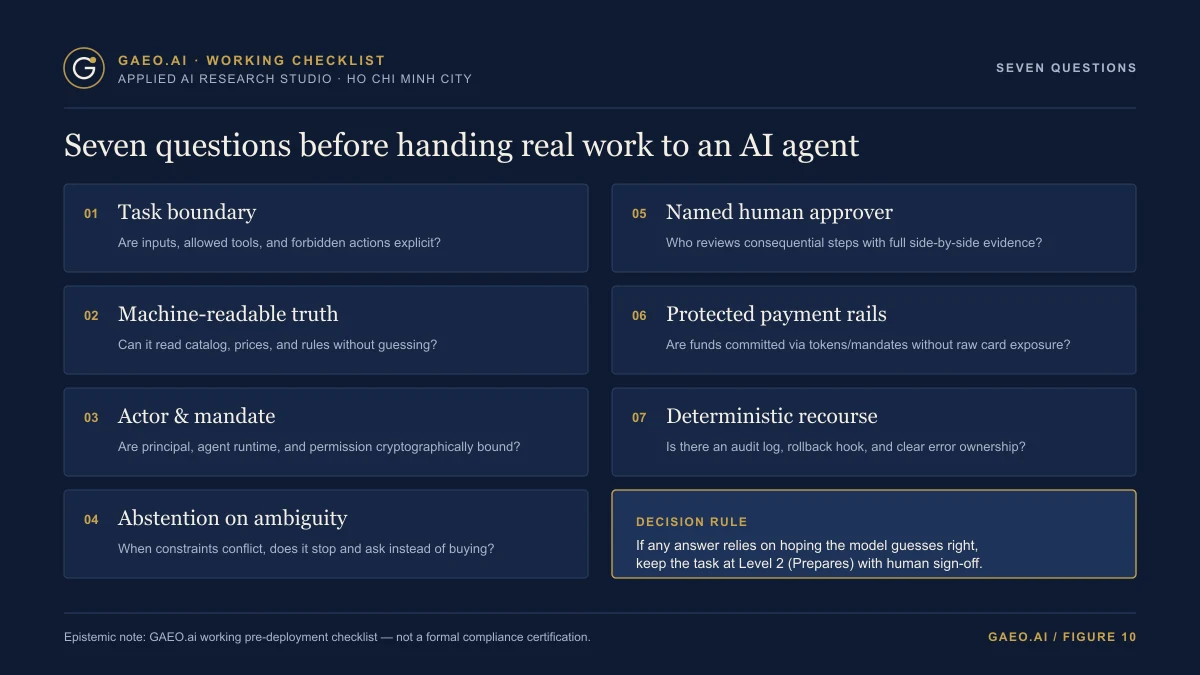
- GAEO.ai Working Checklist, Seven questions before you hand real work to an agent: gaeo.ai/insights/seven-questions-before-handing-work-to-an-agent