
Direct Answer (Thesis): Visa's November 2026 evaluation of 22 AI models from 12 labs across 15 shopping challenges (three attempts each) exposes the central operational risk of agentic commerce: models failed 42.8 percent of runs, yet 54 percent of those failed runs still ended in a completed purchase. For merchants and payment teams, an over-eager agent that buys confidently and wrongly is far costlier than an agent that pauses to ask a clarifying question—making multi-run consistency more important than single-run peak accuracy.
Epistemic note: The empirical test statistics in this note come from Visa's 5 November 2026 press release cited under Sources. The operational interpretation and mapping onto The Agent-Ready Stack reflect GAEO.ai's working framework, not an official Visa specification or industry standard.
Inside the Numbers: Peak Capability vs. Operational Consistency
Most AI benchmarks highlight how well a frontier model performs on a single attempt. Commerce operations cannot run on best-case demos, because every failed order triggers real payment settlement, fulfillment cost, customer support, and return logistics.
Visa's benchmark tested 22 AI models from 12 labs across 15 distinct shopping challenges, repeating each challenge three times per model to measure both accuracy and repeatability. Five numbers stand out for merchants preparing their storefronts for autonomous buyers:
- 42.8% overall run failure rate: Nearly half of all attempted shopping runs failed to satisfy the challenge requirements.
- 54% of failed runs still purchased: More than half of the time when a model failed the task, it did not stop or abstain—it still completed a purchase.
- 82.2% vs. 28.9% model spread: The top-performing model passed 82.2 percent of runs, whereas the lowest-performing model passed 28.9 percent.
- 34.2% three-run consistency: Only 34.2 percent of scenarios passed across all three attempts (
3/3), demonstrating substantial run-to-run variance even on identical shopping tasks.
How to interpret the benchmark
Visa's scenarios test whether an agent uncovers the shopper's requirements and completes the task under those constraints. The 54% figure is conditional on failure. It cannot be read as the share of all shopping-agent purchases that were incorrect. The 34.2% figure tests repeatability at the model–scenario level. Results from these selected models and challenges do not establish a production failure rate across merchants.
Why Buying Wrong Is Worse Than Not Buying
In human e-commerce, friction at checkout mainly costs conversion. If a shopper is unsure whether an item fits a compatibility rule or arrives before Friday, the shopper hesitates or abandons the cart.
In agentic commerce, the failure mode flips. Language models trained to complete user instructions often treat task completion as success even when a hard constraint is violated. When 54 percent of failed runs still end in a purchase, merchants absorb downstream operational damage:
- Preventable returns and reverse logistics: Wrong variants, missed delivery windows, or incompatible accessories turn gross merchandise volume into net margin loss.
- Disputed mandates and chargebacks: When a consumer discovers their assistant bought an item that violated their prompt, liability between the consumer, the agent platform, the merchant, and the card issuer becomes contested.
- Erosion of delegated trust: A single mistaken purchase makes users reluctant to grant standing spending permissions in future sessions.
Summary Diagnostic Table for Merchants
| Benchmark Signal (Visa, 5 Nov 2026) | Observed Figure | Operational Meaning for Merchants (GAEO.ai Lens) |
|---|---|---|
| Overall run failure rate | 42.8% of runs failed | Do not assume external shopping agents parse ambiguous HTML product pages accurately. |
| Failed runs ending in purchase | 54% still bought | Checkout APIs need deterministic constraint validation before payment capture, not blind acceptance. |
| Best vs. worst model pass rate | 82.2% vs. 28.9% | Traffic arriving at your site will span wide capability gaps across 12+ model providers. |
| Passed all three attempts | 34.2% of scenarios | Evaluate your own store's agent readiness across repeated trials, never a single happy-path test. |
Four Practical Takeaways Through the Agent-Ready Stack
Applying GAEO.ai's Agent-Ready Stack working framework to these findings points to four concrete priorities for retail, e-commerce, airline, and fintech teams:
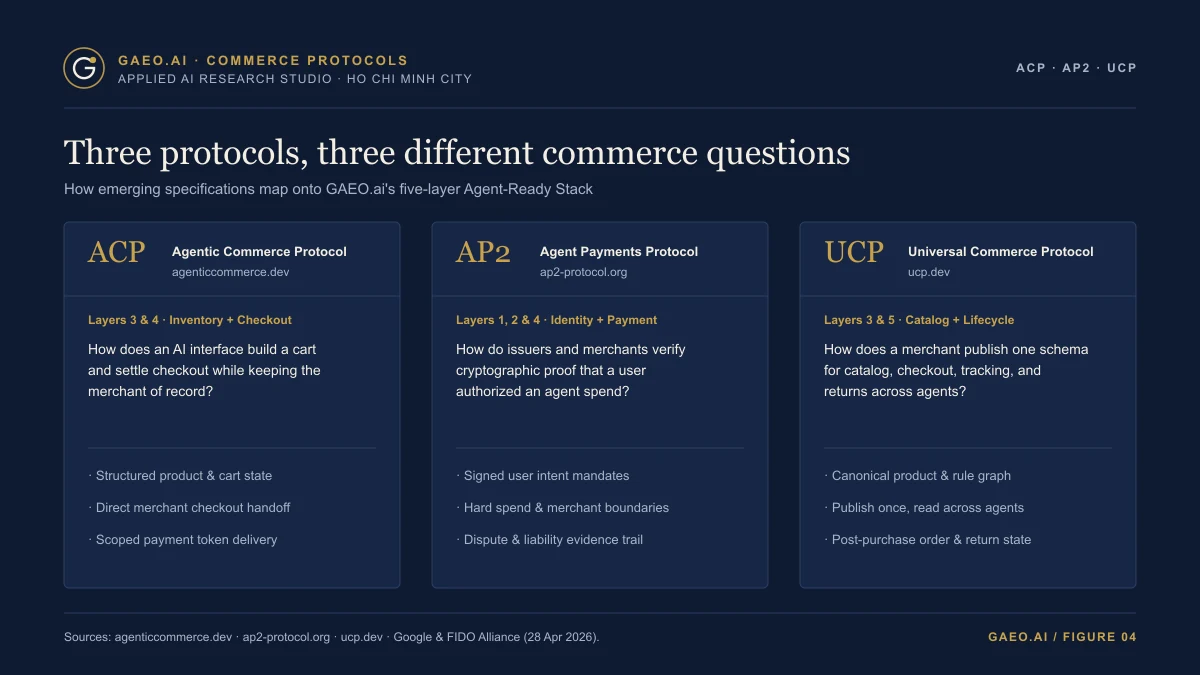
- Make constraints unambiguous at the Inventory layer: Publish machine-readable stock status, variant dimensions, total landed cost, delivery cutoffs, and return eligibility in structured HTML, aligned Schema.org JSON-LD, and protocol feeds (
ACP,UCP) so an agent never has to infer rules from promotional prose. - Enforce hard bounds at Permission and Payment: Cryptographic payment mandates (
AP2) and tokenized spend caps (Payment) limit blast radius when a weaker model (28.9%pass rate) misreads an offer. - Design checkout endpoints that reward clarification: When required order parameters are missing or conflicting, merchant APIs should return explicit, machine-parseable validation errors that prompt the agent to ask the human user rather than guessing.
- Build deterministic Recourse: Because 34.2 percent three-run consistency means exceptions remain routine, maintain clear grace-period cancellation hooks, auditable order logs, and a named human escalation path.
Sources
- Visa Press Release (5 Nov 2026), 22 AI models from 12 labs evaluated across 15 shopping challenges: usa.visa.com
- Agentic Commerce Protocol (ACP): agenticcommerce.dev
- Agent Payments Protocol (AP2): ap2-protocol.org
- Universal Commerce Protocol (UCP): ucp.dev