
Direct Answer (Thesis): Deciding whether to deploy an AI agent is rarely a binary choice between manual chat and full automation. In GAEO.ai's working framework, every operational workflow can be scoped to one of four levels of autonomy: 1. Suggests, 2. Prepares, 3. Acts within limits, and 4. Acts unattended. Selecting the right level depends not on how fluent the model sounds in a demo, but on task reversibility, data clarity, multi-run consistency, and accountability when an error occurs.
Epistemic note: The four levels of autonomy (Suggests, Prepares, Acts within limits, Acts unattended) constitute GAEO.ai's working framework for operational design and governance discussions. They are an analytical lens, not an industry standard, regulatory classification, or safety certification.
Why Autonomy Must Be Chosen Per Task, Not Per Platform
Teams adopting agentic software often ask whether a vendor platform is "autonomous." In practice, a single business workflow—such as resolving an airline schedule disruption, processing a retail return, or reconciling an e-commerce supplier invoice—contains sub-tasks with vastly different risk profiles.
Recent empirical benchmarks show why blanket autonomy is risky. In Visa's November 2026 evaluation of 22 AI models across 15 shopping challenges (three attempts each), models failed 42.8 percent of runs, 54 percent of failed runs still completed a purchase, and only 34.2 percent of scenarios passed on all three attempts. Meanwhile, McKinsey's August 2026 survey (1,719 respondents in 97 countries) highlights active risk management of agents and workflow redesign among the practices separating the 6 percent of AI high performers.
Matching autonomy to operational risk prevents teams from either stalling permanently in chat pilots or exposing live systems to unguarded writes.
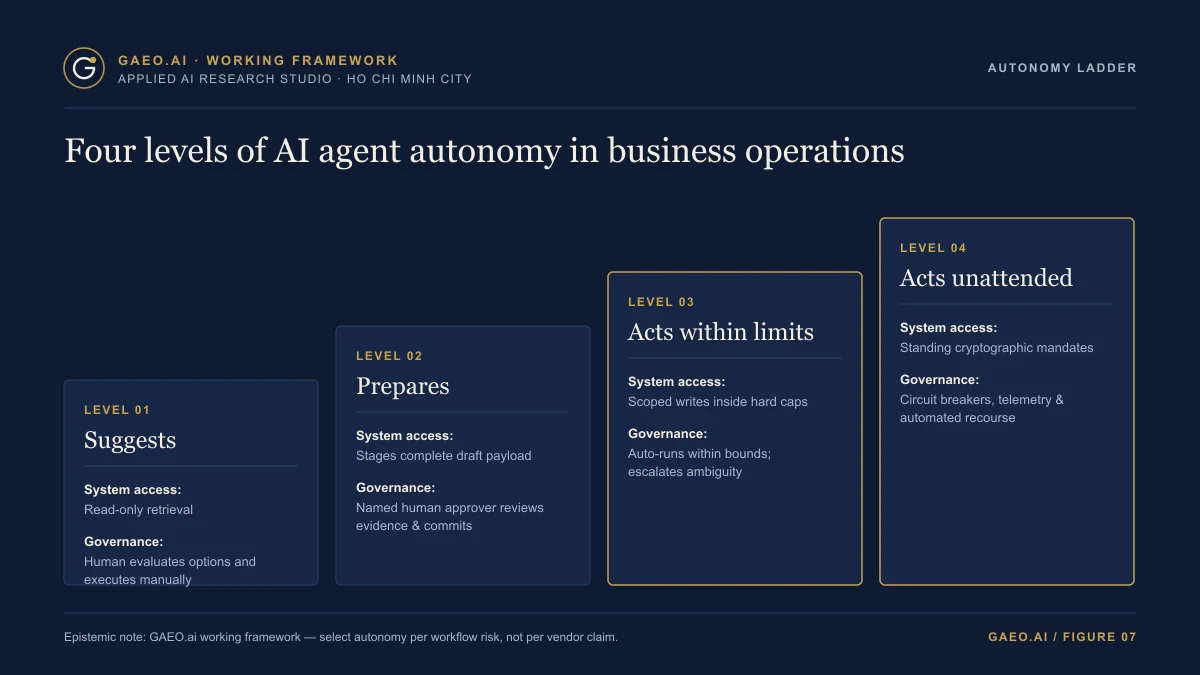
GAEO.ai's Four Levels of Agent Autonomy
Level 1 — Suggests
The agent reads unstructured and structured inputs, retrieves relevant policies or product records, and proposes ranked options or draft responses. It holds read-only access to operational systems. A human operator decides what to do and manually carries out the action in the target application.
- Best fit: High-ambiguity advisory work, early shadow-mode evaluation, or domains where underlying product and policy data remain fragmented.
Level 2 — Prepares
The agent gathers all required context, runs deterministic validation checks, and stages a complete, ready-to-execute payload—such as a pre-filled refund voucher, a draft procurement cart, or a re-accommodation itinerary—alongside the exact evidence used. A named human approver inspects the side-by-side evidence and commits or rejects the staged action.
- Best fit: Consequential or hard-to-reverse decisions where assembling context takes minutes of staff time, but final judgment requires human accountability.
Level 3 — Acts Within Limits
The agent executes bounded, reversible transactions automatically whenever deterministic guardrails are satisfied: explicit spend caps, approved merchant or SKU lists, verified stock, and zero conflicting constraints. Whenever an input falls outside those limits—or when policy data is ambiguous—execution halts and routes to a named human approver.
- Best fit: High-volume operational routines with clean machine-readable rules, scoped payment or API tokens, and straightforward rollback paths.
Level 4 — Acts Unattended
The agent executes end-to-end across a defined workflow without per-transaction human review. Because no human inspects individual runs before commitment, Acts unattended requires cryptographic delegation mandates, real-time anomaly circuit breakers, immutable intent-to-action audit logs, and automated post-transaction recourse hooks.
- Best fit: Narrow, deterministic machine-to-machine operations with proven multi-run consistency, strict blast-radius ceilings, and automated reversal guarantees.
Summary Decision Matrix (GAEO.ai Working Framework)
| Autonomy Level | System Access | Human Role | Minimum Prerequisite Before Advancing |
|---|---|---|---|
| 1. Suggests | Read-only context retrieval | Evaluates options and executes manually | Baseline retrieval accuracy and source citation |
| 2. Prepares | Read + stage draft payloads (no live commit) | Named approver reviews evidence and signs off | Structured state schemas and side-by-side review UI |
| 3. Acts within limits | Scoped write access inside hard caps | Approves out-of-policy exceptions and audits logs | Deterministic validation rules, abstention on ambiguity, rollback hooks |
| 4. Acts unattended | Standing delegated mandates within circuit breakers | Governs policy thresholds, monitors telemetry, owns recourse | Proven multi-run consistency, tokenized payment/action rails, full auditability |
Earning the Right to Move Up a Level
In GAEO.ai's advisory work, advancing a workflow from Prepares to Acts within limits—or from Acts within limits to Acts unattended—should be gated by observed operational evidence:
- Measure shadow-mode or staged-draft agreement rates across repeated runs before enabling automated writes.
- Verify that the agent reliably pauses and asks a question when constraints conflict, rather than forcing completion.
- Confirm that every layer of The Agent-Ready Stack (Identity, Permission, Inventory, Payment, and Recourse) is explicitly engineered for the target level.
Sources
- Visa Press Release (5 Nov 2026), 22 AI models tested across 15 shopping challenges: usa.visa.com
- McKinsey & Company, "The state of AI in 2026: On the road to ROI" (25 Aug 2026): mckinsey.com
- GAEO.ai Working Framework, From Answers to Actions: gaeo.ai/insights/from-answers-to-actions