
Direct Answer (Thesis): Moving an enterprise workflow from conversational AI (answers) to autonomous execution (actions) requires shifting focus from model size to operational governance. Every production agent workflow at GAEO.ai begins with two non-negotiable primitives: a strictly bounded task (explicit inputs, allowed tools, and validation rules) and a named human approver accountable for consequential decisions and exceptions.
Epistemic note: The bounded-task and autonomy transition model described here is GAEO.ai's working framework for operational design, not a formal industry standard or compliance certification.
Why Chat Interfaces Tolerate Ambiguity That Action Systems Cannot
When an employee or customer asks a chat assistant a question, the cost of a slightly imprecise answer is buffered by human judgment. The reader scans the response, notices if a policy detail looks off, and decides what to do next.
The moment an AI system is given write access—updating an order record, issuing a refund, rebooking a disrupted passenger, or submitting a procurement request—that human buffer disappears unless it is deliberately engineered into the workflow.
In our research across retail, fintech, e-commerce, and airlines, teams that stall between pilot demos and production deployment almost always make the same mistake: they try to solve an operational governance problem by prompting a model harder.
Primitive 1: The Bounded Task
An open-ended instruction such as "Handle customer order exceptions" is not an agent specification; it is a recipe for unpredictable blast radius. Before granting an AI agent tool-calling permissions, the task itself must be bounded across four dimensions:
| Dimension | Unbounded Chat Prompt | Bounded Operational Task |
|---|---|---|
| Input Context | Free-text conversation history alone | Validated state payload (order ID, customer tier, inventory status, policy version) |
| Allowed Actions | Unrestricted API or database write access | Explicitly scoped tool calls (e.g., draft_refund_proposal, hold_replacement_stock) |
| Validation Rules | Model self-reflection ("Are you sure?") | Deterministic code checks (refund amount ≤ item price, eligibility window ≤ 30 days) |
| Blast Radius | Can modify live production state silently | Prepares staged state changes or executes only within pre-approved monetary thresholds |
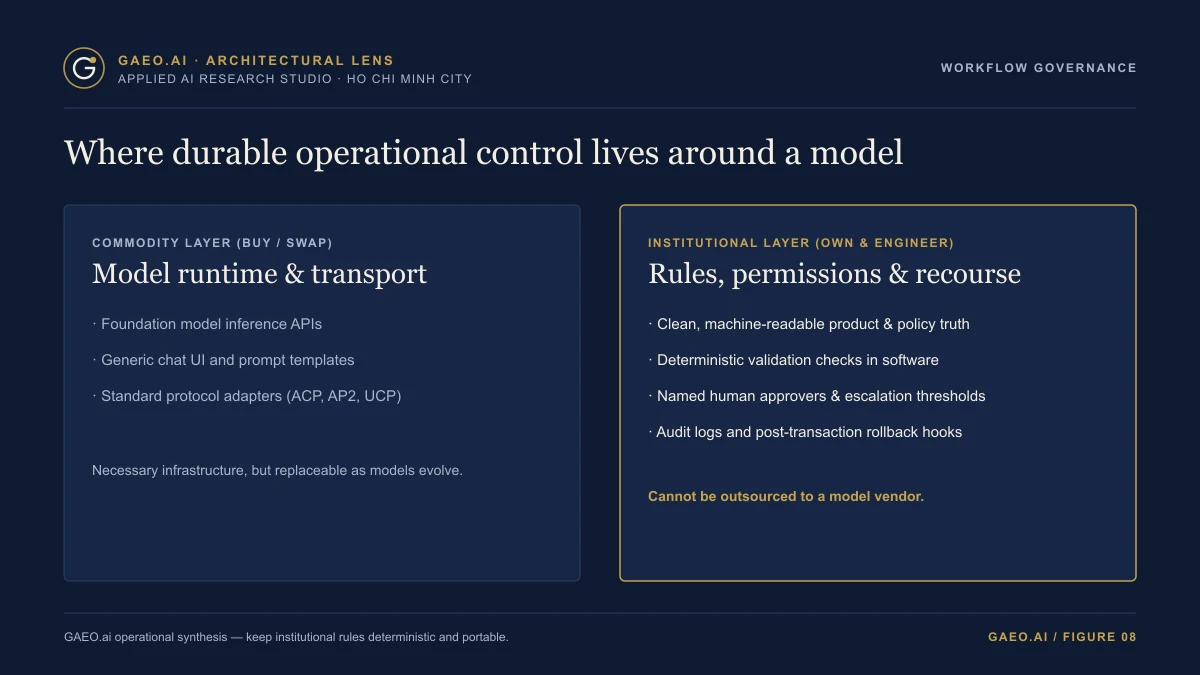
When a task is properly bounded, the language model handles what it is genuinely good at—interpreting unstructured requests, synthesizing context across documents, and proposing a structured action—while deterministic software enforces the rules.
Primitive 2: The Named Human Approver
"Human-in-the-loop" is one of the most overused phrases in AI governance. In practice, a generic review queue watched by "the operations team" quickly degrades into rubber-stamping—where tired operators click Approve on dozens of AI suggestions per hour without sufficient context to spot a subtle error.
In GAEO.ai's operational methodology, human oversight only works when there is a named human approver with three clear attributes:
- Decision Context: The interface presents the exact evidence the agent used (the customer claim, the applicable policy clause, and the financial impact) side-by-side with the proposed action—not just a summary paragraph.
- Scoped Authority: Explicit thresholds define which low-risk, reversible actions the agent can complete automatically, and which consequential or irreversible actions require the named approver's signature.
- Recovery Ownership: If an approved action fails downstream, the named approver and the system designer have a documented rollback procedure (
Recoursein The Agent-Ready Stack).
The Four-Stage Transition Blueprint
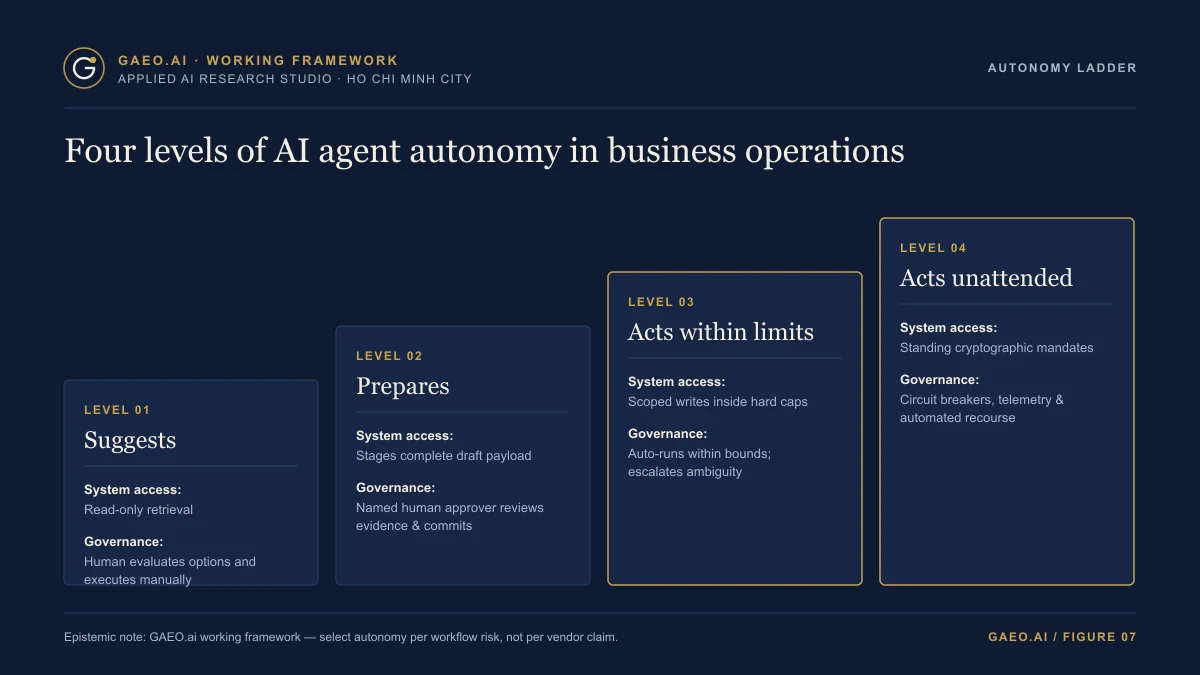
For organisations moving a workflow from answers to actions, we recommend a staged progression:
- Shadow Mode (Observe): The agent reads live operational inputs and logs the action it would take alongside the actual action taken by human staff. Measure divergence before enabling any write access.
- Draft & Prepare (Assist): The agent gathers all required records, checks policy constraints, and stages the transaction payload for a named human approver to execute with one click.
- Bounded Autonomy (Act within Guardrails): Low-value, fully reversible actions that pass deterministic policy checks execute automatically; edge cases and high-value transactions escalate to the named approver.
- Exception-Driven Audit (Maintain): Every automated and escalated decision is logged with full provenance, and failure modes are fed back to tighten task boundaries.
Sources
- McKinsey & Company, "The state of AI in 2026: On the road to ROI" (25 Aug 2026): mckinsey.com
- GAEO.ai Working Framework, How much should an agent do on its own? Four levels of autonomy: gaeo.ai/insights/four-levels-of-agent-autonomy
- GAEO.ai Working Framework, The Agent-Ready Stack: gaeo.ai/insights/the-agent-ready-stack